Wednesday, August 10, 2016

"Sharenting" and Social Media: Endangerment or celebration of a global community?


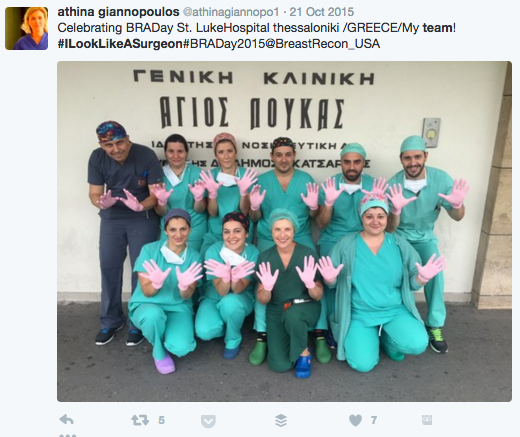
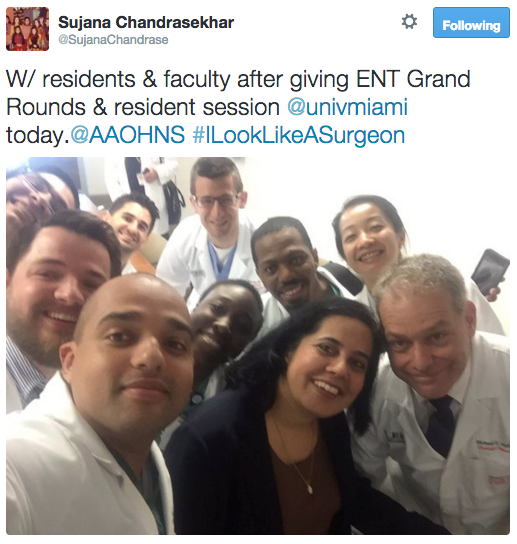
After signing onto Twitter for the first time in 2011, there have been two events that have triggered my absence. The first was the birth of my daughter, Sierra, in 2013, and the second has been the birth of my son, Orion, this past May. Both times I have found caring for a newborn to be all-consuming--swadling, nursing, and bathing the little one left no time for social media. Since the #ILookLikeASurgeon movement, it has been much more difficult being “away” from my social media community. When the #ILookLikeASurgeon hashtag was born, there was no question that I wanted to post a photo celebrating both surgery residency and motherhood. Some may be surprised to learn it was the first time I posted a photo of Sierra online. Until that moment I had shared very few photos of my personal life online.

After Orion was born, I was eager to celebrate the new addition to our family with my global network of social media friends, yet I found myself hesitating. I questioned the potential dangers of sharing photos of my children on social media. While it is generally accepted that there are “risks” involved in posting photos of one’s children online, I had seen very little in terms of specifics on these risks. Before jumping back into social media, I decided to do my own research in order to make an informed decision when it came to posting photos of my children. Given the popularity of the #SurgParenting hashtag, I thought others might be interested in what I found.


First, I would like to share some statistics on the elephant in the room--the vast majority of children born in the United States today find themselves online from the day they are born. Perhaps earlier, if we count ultrasound photos. Studies show that 92 percent of kids in the United States have an online identity by age 2.[1] On average, parents post nearly 1,000 photos of a child online before the child turns 5.[2] It’s no wonder non-parents can feel they are drowning in “cute” photos of their friends’ children. Why all the posts? According to a 2015 survey by Pew Internet Research, 74% of parents who use social media get support from their friends online.[3] Surgeons appear to be no exception.

Are we “oversharenting”? Oversharing seems to be judged in the eyes of the beholder. A survey by Parents magazine found that 79% of respondents said other parents overshare on social media -- yet only 32% felt that they overshared themselves.[4] Similarly, when asked to judge others, 80% of adults say they’ve seen parents put attempts to get the perfect photo ahead of their child’s enjoyment of an event.[5] While these statistics are striking, I argue it matters more that parents and their children are comfortable with the photos than what others think. For a great post on a parent and child who are both mindful and enthusiastic in their approach to social media, see here.

I had a difficult time finding examples of negative consequences of parents sharing photos of their children. Extensive googling and article skimming revealed only two examples of misappropriation of photos posted online.[6] Many of the dangers cited in articles discussing the cons of photo sharing seem ephemeral. While it’s true that future college admissions committees, employers, loan officers could peruse baby photos of my children someday, I can’t help but wonder why? Predatory behavior from pedophiles is also frequently cited as reason not to post photos of one’s children. However Prof. David Finkelhor, director of the Crimes Against Children Research Center at the University of New Hampshire, says “this is not the way it happens” and that such dangers are falsely inflated. While it’s true predators seek victims in chat rooms, they do not peruse photos posted by adoring parents.
One study found that 58% of respondents admit posting the perfect picture has prevented them from enjoying life's experience. According to the study’s co-author, Joseph Grenny, “We enjoy important life moments less when we’re focused on capturing them rather than experiencing them.”[7] Does this mean we must put our phones away and forgo sharing the moment with friends and strangers? Not necessarily. Rather than being controlled technology, it can be used to draw us into an experience. A photo can become  memento to treasure and share.
A recent survey of children 10 to 17 found that nearly 1 in 5 wanted control over the information their parents posted about them online.[8]  Catherine Steiner-Adair, author of“The Big Disconnect: Protecting Childhood and Family Relationships in the Digital Age” and research associate at Harvard Medical School’s Department of Psychiatry, suggests that “Kids should have veto power over the pictures we take and post on social media. We need to teach children the message that we own our body and we own our image and ask questions like, ‘Would you mind me sending it to grandma or grandpa?’”[9]
Photo Credit

Rather than worrying about unrealistic dangers, I recommend three questions to ask yourself when posting photos of children.
  1. What is the purpose of a my post? (For a powerful example of a post with a clear purpose, see here.)
  2. Am I comfortable with this image/information becoming part of my child’s digital footprint?
  3. Would my child approve? And do I have their permission? (If consent is age-appropriate.)
If you are not a parent, and are considering posting a photo of a niece, nephew, or friend’s child, I recommend asking yourself same questions and then checking with their parent for permission.
What are the benefits of posting online photos? Many parents find that virtual sharing allows them to build an online community and connect with other parents. Particularly for parents living away from family, sharing special moments through social media can foster a sense of community and support, providing a network of “friends” they would never have access to otherwise. While children may not directly benefit from this online community, they have a lot to learn from parents who include them in the process. Understanding the magnitude and significance of their digital footprint is a “life skill” that will serve them well as they enter adolescence and beyond.
What did I decide? For me and my family, the benefits of sharing outweigh the risks. While my husband chooses a very limited online presence for himself, he is comfortable with the thoughtful choices I make in posting photos of our children. I hope the snapshots and moments I chose to share make them feel cherished and celebrated. Rather than a detriment, I hope the posts serve as a sort of “virtual memory book” highlighting positive moments of their childhood. As they grow, I will involve them more and more in the process of choosing which photos and moments are appropriate for sharing.
In the meantime, I am excited to share special family snapshots with our global friends and family. I never dreamed I would celebrate my newborn son hiking with a surgeon, @dr_imogen, I met through #ILookLikeASurgeon and now affectionately refer to as his Australian Godmother.

Welcome to the world Orion. #AdventureAwaitsYou


[1] "American Girls - Time." 2016. 28 Jul. 2016 <http://time.com/americangirls/>
[2] "Read this before posting photos of your kids on Facebook - MarketWatch." 2015. 29 Jul. 2016 <http://www.marketwatch.com/story/read-this-before-posting-photos-of-your-kids-on-facebook-2015-08-05>
[3] "Parents and Social Media | Pew Research Center - Pew Internet ..." 23 Jul. 2016 <http://www.pewinternet.org/2015/07/16/parents-and-social-media/>
[4] "How Social Media Is Affecting Your Parenting - Parents." 2015. 23 Jul. 2016 <http://www.parents.com/parenting/better-parenting/style/how-social-media-is-affecting-your-parenting/>
[6] "Guardians of Their Smiles - The New York Times." 2009. 5 Aug. 2016 <http://www.nytimes.com/2009/10/25/fashion/25facebook.html>
[7] "Society's New Addiction: Getting a “Like” over Having a Life - Press ..." 2015. 8 Aug. 2016 <https://www.vitalsmarts.com/press/2015/03/societys-new-addiction-getting-a-like-over-having-a-life/>
[9] "Read this before posting photos of your kids on Facebook - MarketWatch." 2015. 4 Aug. 2016 <http://www.ma

Sunday, June 19, 2016

To all the dads who say #ILookLikeASurgeon, Happy Father’s Day!

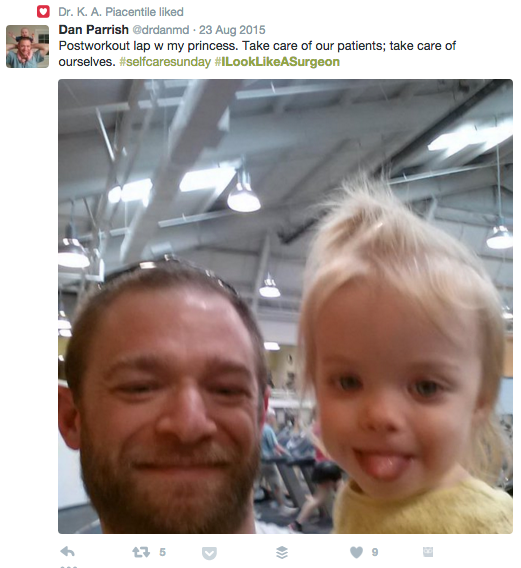
I’d like to express my gratitude to the male surgeons who have shared the joys and challenges of parenting with me personally as well as with the Twitterverse. I have been touched and inspired by conversations of balancing family and career with both male attendings and residents. For those of us who enjoy #SurgTweeting, I think we have all smiled at the #SurgParenting pics that pass through our Twitter feed.


Synergistic with the role modeling shared through the #ILookLikeASurgeon movement, seeing the #SurgParenting photos of male surgeons integrating career and family life has been inspiring for all genders.

#SurgDads, thank you!


Wednesday, February 3, 2016

#SurgTweeting: Understanding Data Visualizations of Twitter Communities Using #ACSCC15

2015 was an exciting year for Twitter at the Clinical Congress of the American College of Surgeons. The #ACSCC15 selfie contest catapulted off the #ILookLikeASurgeon movement with vigor. The contest drew in a plethora of Twitter neophytes who posted their first tweets at the Congress, leaping into #SurgTweeting.
According to Twitter data analytics from Symplur, #ACSCC15 had record Twitter participation with over 50 million impressions, 14,000 tweets and over 2,500 participants. Statistics, however, only tell part of the story; they do not reveal the interactions and interconnections of those who tweeted. In other words, they reveal little about the network. To illustrate these connections, Twitter data can be organized graphically into interactive network visualizations.
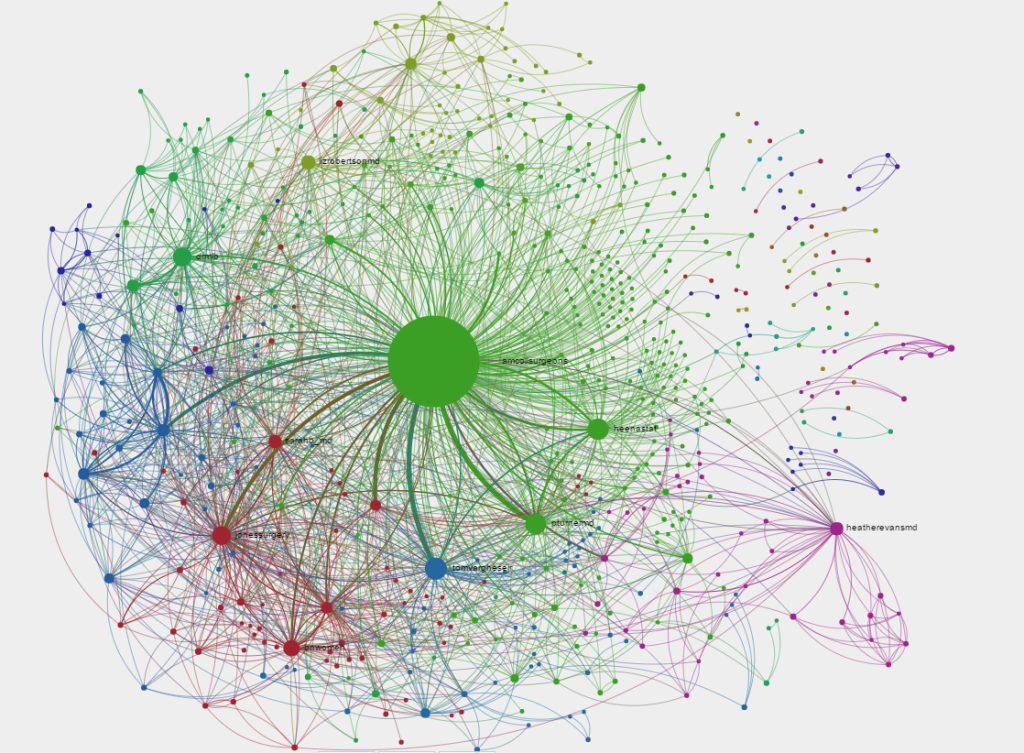
Using Twitter’s API, I (Mookie Thayer, of @PresentServices) built interactive data visualizations for #ACSCC14 and #ACSCC15. These visualizations were created using the mentions, favorites and retweets of all tweets that included the conference hashtags. The #ACSCC14 network visualization of mentions and retweets can be viewed below.
2014_example
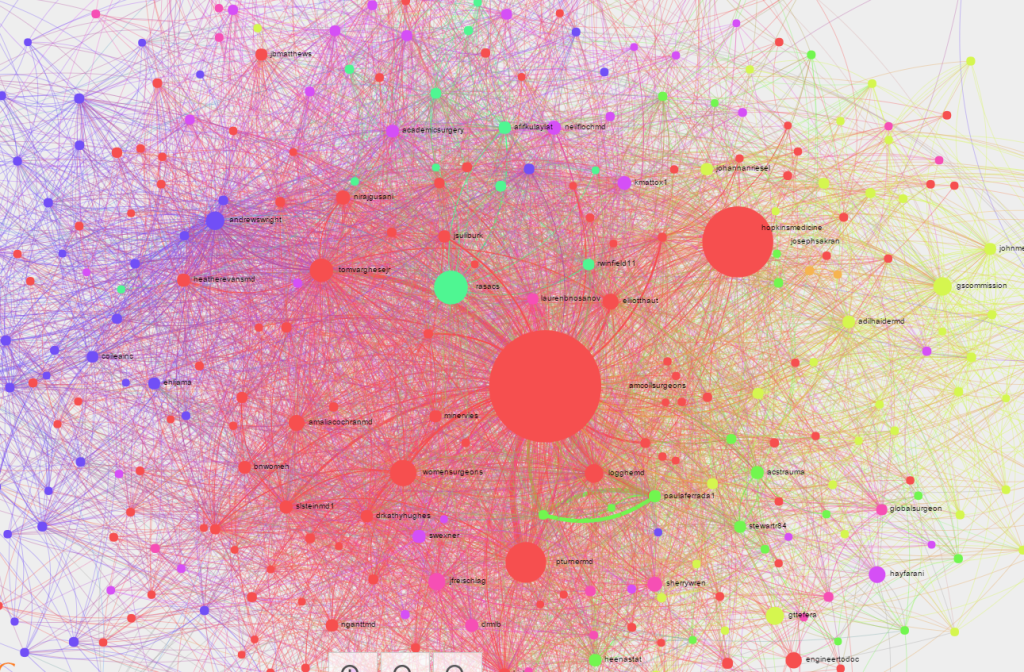
The dots or “nodes” represent Twitter users such as @AmCollSurgeons and @WomenSurgeons. Hovering over a node reveals the username. Connecting lines represent interactions such as a mention, favorite, or retweet. The colors highlight “communities” or “conversations” revealing sub-networks within the overall conference dialogue. Clicking on a node highlights the network of the selected user, allowing you to view the individual user’s impact and participation in the overall network. Being able to visualize the network of an individual user serves as a proxy for their influence within the Twitter community. For example, click on the pink node in the bottom right; you will see the sub-community of @heatherevansmd. Notice the multiple nodes connected only to her. Those are her colleagues back at home, participating in #ACSCC14 through Dr. Evans.
#ACSCC15 – Massive growth of conversations and users


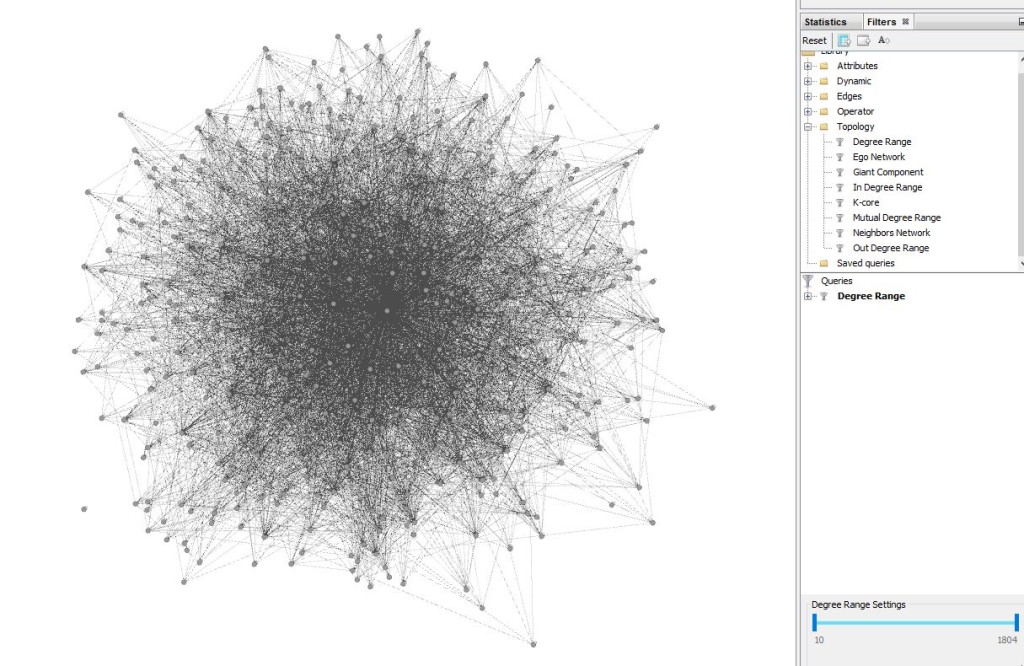
To establish the data set, I imported all the tweets that contained a “mention” (i.e. @name), those that had been favorited or “liked”, and all retweets. The initial visualization of this much larger group of tweets from #ACSCC14 looks like an explosion of connected points. To make it more legible, I then limited the data points to nodes of users with 10 or more mentions/favorites/retweets.
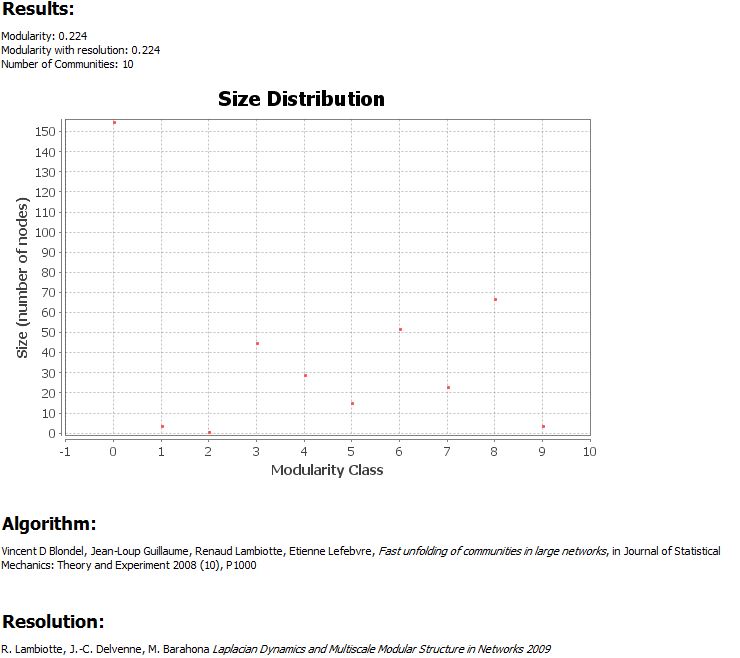
10_degree_nodesMultiple algorithms were used to determine data points of interest. For example, the “Degree Distribution Average” (i.e., the average number of connections to each node) was a bit over 4 Twitter users per community, but only the top 10 communities are color-coded.
The “communities” were determined by calculating the modularity of the tweets and colorizing those users whose tweets demonstrated intense modularity. Modularity is a measure of the strength of division of a network into modules (also called groups, clusters or communities); in this case the modularity increases with increased strength of interactions as measured by retweets, replies, and favorites.
modularity_size_distnon-weighted_10_graph
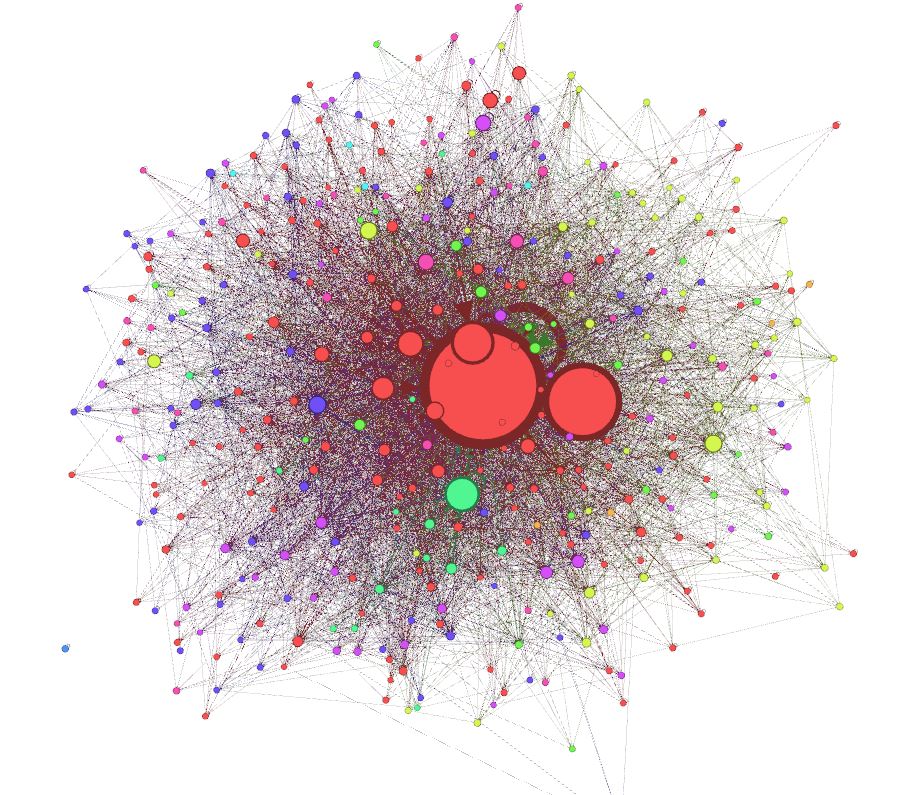
Once the nodes were colorized based on their communities, the nodes (i.e. users) were weighted based on volume of mentions, retweets, and favorites.
weighted_10_graph
Finally the visualization was manipulated for clarity by expanding the spacing, adding and removing gravity from the weighted objects, adjusting alignment, and labeling.
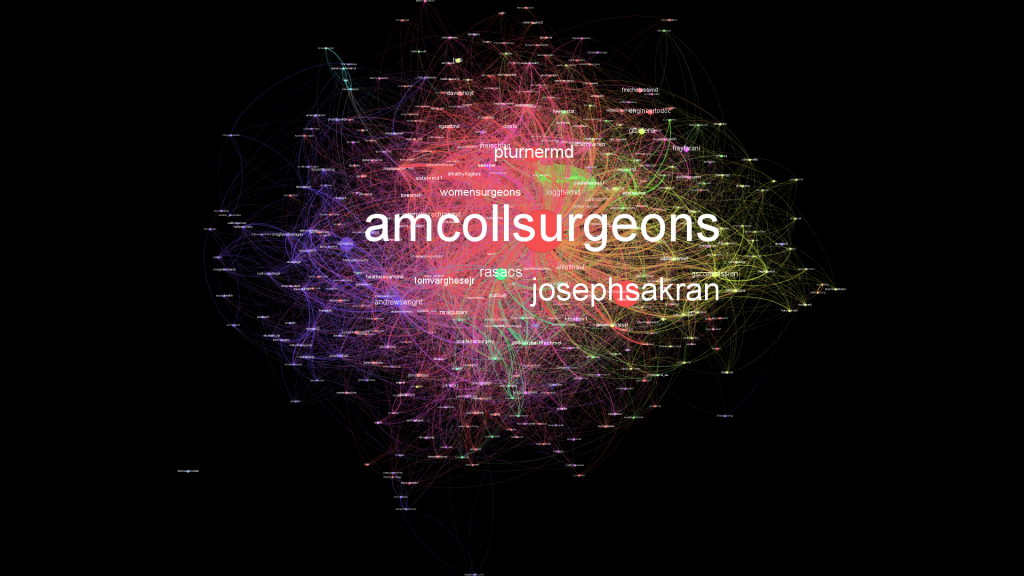
This non-interactive version is 1080p with a black background. Download it to zoom in to see all those users and connections!
ACSCC15_Master_1080
1080p – High-res version of #ACSCC15 Twitter user network.
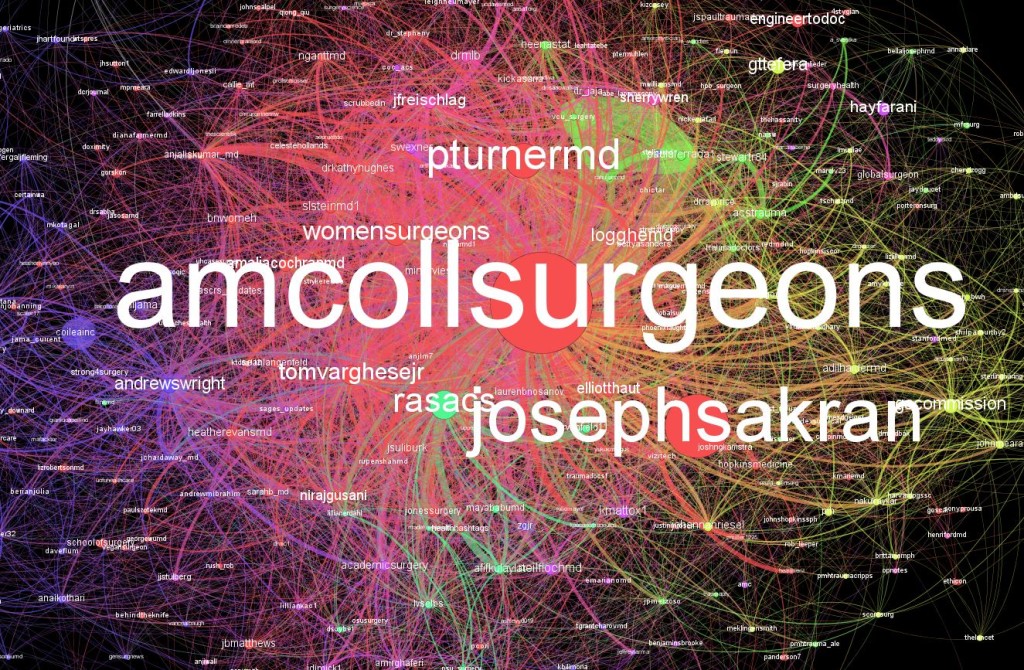
pretty_weighted_10_graph_labeled_2
Zoomed in Screenshot
The last step is to take the data and make it more interactive, enabling the user to view the network as a whole as well as to break down each user’s network. (The programming involved in this is beyond the scope of this blog.)
2015_example
#ACSCC15 – Twitter User Network Data Visualization
Click here for the interactive version of #ACSCC15
What changes do you see between 2014 and 2015? Look at the number of followers many of the users picked up over time. Who were the major Twitter influencers at the conference each year? What surprises came out of the visualizations?
Similar visualizations will be created for the 2016 Academic Surgical Congress. Follow @presentservices for future visualizations of the #ASC2016 Twitter communities.  You can discuss and ask questions in our comments section, or you can always tweet me.
I’d also like to thank Heather Logghe and Christian Jones for helping me co-author and explain the data for this project.
– Matt “Mookie” Thayer – @presentservices

Tuesday, February 2, 2016

#ILookLikeASurgeon: Unraveling the myths and stereotypes of the "surgeon personality"

Since #ILookLikeASurgeon went viral last August, I have had the opportunity to talk with surgeons the world over as to why they think the hashtag struck a collective nerve of passion and positivity. One of the most insightful conversations was with Drs. Michael Conlin and Dan Parrish. Their perspective was that #ILookLikeASurgeon was the first time surgeons were empowered to shape their public persona. Rather than being powerless victims of their portrayal in the media and popular press, surgeons themselves have an opportunity to say, “This is who we are; this is what we look like.” As Dan put it, “We [surgeons] are being seen as social media savvy, fun, diverse, accepting, hard-working, and most of all, as human.”


Public perceptions of surgeons matter; fear of an intimidating surgical persona can prevent patients from seeking needed care, undergoing potentially beneficial surgery, and complying with treatment plans. Biases rooted in negative perceptions can influence patients’ hospital experiences and consequently physician ratings. These perceptions also influence those who choose to enter the profession; sadly the world may be missing out on caring and perceptive surgeons due to inaccurate stereotypes of the “surgical personality.”


A recent opinion article titled, “There is no place for the surgeon myth in modern medicine,” by Alexis Sobel Fitts provoked ire within the surgical Twitter community for its “misguided opinion” and being “uneducated and poorly researched.” Despite being an aspiring surgeon, I was not offended by the article as I felt Ms. Fitts was writing sincerely from her own personal perceptions and delving into surgical history in an attempt to make sense of them. Ms. Fitts describes being motivated to write the article after hearing her sister’s generalizations of lack of diagnostic skill among surgeons that were inculcated during her first year of medical school. I believe Ms. Fitts was struck by the discordance of her sister’s observations with the heroism, glamour, and grandeur she had seen portrayed by surgeons in the media.


In an attempt to explain this discordance, Ms. Fitts’ article details the history and evolution of modern surgery--from the Middle Ages’ ‘barber-surgeons’ when surgeons were at the bottom of the medical hierarchy to the implementation of modern anesthesia and antiseptics, culminating in the image of an “outsize personality required to carve into a human body.” She goes on to state, “An operation is performed within a distinctly macho context: a showdown between disease and individual doctor, leading a team through authoritative decision-making. Surgeons are valued for their ability to execute, not analyse.” I suspect many surgeons would disagree strongly with these statements. Still, it’s important to remember that with the evidence available to her, these are the conclusions the author made.


In fact directly contrary to the stereotype of the decisive and authoritative surgeon, a study on surgical leadership styles by Hu et al. showed that transactional (task-focused) leaders achieve “minimum standards” compared to transformational (team-oriented) leaders who “inspire performance beyond expectation.” Sadly I could find no blog post and only one lay press article conveying these results to the general public. This is unfortunate as the results of the study likely have implications and applications to settings far beyond the operating room. Fortunately the numerous team photos of #ILookLikeASurgeon actively counter this stereotype.


Indeed images are among the most powerful tools to change perceptions. A 1987 image of one of the world’s first heart transplant surgeons, Dr. Zbigniew Religa has literally been dubbed a picture that “changed the world.” Similarly, the images of #ILookLikeASurgeon showing surgeons having fun, with family, exercising, cooking, and living a life outside of the operating room have served to--as blogger Terri Coutee put it--“humanize the profession.” Ms. Coutee further writes,


I have a suspicion, unfounded and non-evidence based though it might be, and I will own it. My suspicion is this; the surgeons who have posted on this Twitter trend have high ratings with their patients. These are the surgeons who respect you as a team member in your health decisions, sometimes tagged as #SDM (shared decision making) on Twitter. These are surgeons who go the extra distance not only as team members with their colleagues but spend the extra time it takes to research evidence based medicine (#EBM) to hone their practice and skill achieving the best in patient outcomes.

Surgeon authors Drs.
Atul Gawande and Pauline Chen as well as surgeon bloggers such as Dr. Nikki Stamp and guest posts on KevinMD such as this one on teamwork by Dr. Starla Fitch provide insight to the general public on the experience of both becoming and living life as a surgeon, bridging what sometimes feels an uncrossable chasm between the often contrasting lives of surgeons and their patients. Given surgery is one of the most intimate forms of healing, it should come as no surprise that patients seek a connection and understanding with those they grant this intimate invasion.

 
In the end, I feel the lack of congruity between the title and the content of Ms. Fitts’ article is most revealing; by stating, “There is no place for the surgeon myth in modern medicine,” Ms. Fitts suggests she does not believe the existing stereotypes and media portrayal of modern surgery are true. Yet, at the close of the article, it seems she is left yearning for a more realistic definition and image of “surgeon,” one that is both human and a team player. I believe her vision is today’s reality. Follow #ILookLikeASurgeon for surgeons who are living that reality!


Wednesday, December 9, 2015

#ILookLikeASurgeon: The Journey to the First Tweet

Tweeting this:

on August 5 and writing an accompanying blog post, I never imagined #ILookLikeASurgeon would become a movement. I am truly humbled and inspired daily by the powerful, global response the message has generated.


In meeting advocates of the movement at the American College of Surgeons Clinical Congress, I realized that many are also curious about my own story--who I am and what inspires me to start and sustain the movement. While some articles have simplified my background and described me as a “general surgery resident,” it’s actually a bit more complicated than that. Perhaps not surprisingly, my life trajectory has been anything but stereotypical.


Growing up, doctors seemed superhuman; a profession far beyond the reach of anyone in our small, agricultural community. I was raised on a dairy farm in rural Wisconsin, and both my maternal and paternal grandparents and great grandparents were dairy farmers. When I was 6 years old I was asked to draw myself “20 years from now.” I drew myself looking out the kitchen window, doing the dishes. Fast forward to 8th grade “tech ed” class (i.e. woodworking) where we were encouraged to choose a career from the Department of Labor Occupational Handbook. I chose surgery because it combined my love of science and my passion for helping others. Given there were no physicians in our community, there was really no one to tell me I couldn’t do it. Yet in many ways, the paucity of role models from a similar background has led me to question many times whether I “belong.”


When it came time to go to college, I received an academic scholarship to the University of Wisconsin, Madison and thus didn’t feel the need to apply anywhere else. As a first year student, there were more people in my dorm building (1100) than in my entire home town. While geographically a 4-hour drive, it felt worlds away. That first semester my mind expanded to greater dimensions than the previous 18 years combined. College proved to be a time of both professional and personal growth. I majored in psychology and earned a certificate in women’s studies. The women’s studies courses enlightened me to the strong gender socialization I had internalized growing up in rural America. Also, having grown up in an all-white community, I was eager to attend every “diversity” event I could. While Wisconsin may not be the most diverse state in the nation, the community of Madison is passionate about celebrating diversity and promoting equality. Such opportunities included attending courses at the Institute for the Healing of Racism founded by renowned bassist, Richard Davis.


Part of my journey of uncovering and unlearning my own internalized gender stereotypes included healing from personal experiences with sexual violence. I found empowerment in social activism. I started a peer education program, “Silent Crimes, Outspoken Voices,” which used stories of actual survivors of sexual violence to educate peers. We also started a men’s group focused on pro-feminist, gay-affirmative, and anti-racist issues as well as ending male violence against women. Skills and wisdom gained from these experiences have informed my leadership in the #ILookLikeASurgeon movement.


In medical school at University of California, San Francisco, I found tremendous inspiration in my surgical mentors who modeled a strong history of improving public and global health through learning from and giving back to local and global communities. As a student I was encouraged to continue my passion for advocacy, hosting conferences on both domestic violence and bias in medicine. After graduating from medical school, I took a year before residency to have our first child, Sierra. During that time I worked with a few health tech startups in Silicon Valley. It was a formative learning experience to witness the challenges at the intersection of medicine and entrepreneurship. It was also inspiring and rewarding to work with the many e-patients advocating for their own health and for positive change in medicine. These experiences brought to life the power of social media to connect patients and physicians and inspire innovation.


When the Monday before Match Day arrived, I clicked open the anticipated email and learned I did not match. I consulted with my mentors and quickly made the long list to whom my application was subsequently sent. That Wednesday I secured a spot as a preliminary general surgery resident at the University of North Carolina Chapel Hill (UNC) and was subsequently invited back for a second preliminary year. I loved my experience at UNC, and continued to be inspired by strong female and male role models. Given the limited time residents enjoy outside of the hospital, I chose to focus on expanding my clinical knowledge and caring for our growing toddler at home, rather than aggressively seeking a categorical position. It was not a surprise last July when UNC did not magically have an opening to offer me as a third year resident and thus my initial plan was to work on research projects, network and apply for a categorical position to complete my general surgery training.

As is often the case, “life is what happens while you’re busy making other plans.”


In early August my husband, Chris, was offered a position opening a battery research lab for Tesla Motors. Chris had set up Tesla’s first battery research lab and left this dream job to be the lead parent while I was in residency. We quickly realized that me taking two years out to do research or industry work would allow Chris the opportunity to return to the workforce for this once-in-a-lifetime project, while at the same time give us the opportunity to have a second child. Given that I developed a cystocele at week 26 of my first pregnancy, it is important that I not be clinical (i.e. on my feet) during pregnancy. It does not serve me or my (present and future) patients to put my health, the pregnancy, or ultimately my career at risk.


It was the culmination of these life experiences that inspired the #ILookLikeASurgeon movement.


Given the magnitude of the movement and the doors it has opened, many have asked me if I plan to return to surgery. The answer is a resounding YES! I love surgery and my goal is to secure a categorical position and complete my training. To me, the privilege of cutting open the human body and healing it from the inside out is the single greatest honor that can be bestowed upon someone. Similarly, it has been an honor and a privilege to lead the efforts of #ILookLikeASurgeon.


Not in my wildest dreams did I think I could impact the world of surgery in this way, especially at such an early stage of my career. Yet, when I look back on my life so far, I have lived my belief that we can inspire and help others on their journey, even as we are in the midst of creating our own.


#ILookLikeASurgeon has uncovered a global community of surgeons who are shedding the outdated surgical stereotype. They forge their own unique paths, maintaining their individuality, and prioritize being both the best people AND surgeons they can be, rather than forcing themselves into an ill-fitting stereotype. Personally and professionally, I—along with countless others—have learned that I am not alone. Surgeons come from all walks of life. The pictures and tweets shared publically, as well as the direct messages shared privately, have been a gift and a responsibility.

So what is next for #ILookLikeASurgeon? My vision for #ILookLikeASurgeon is for it to serve as a supportive community promoting positive change, ideally strengthening the networks of existing surgical organizations in the process. This will be accomplished through the continued conversations on Twitter and Facebook as well as blogs and more formal publications. The message remains the same since the very first tweet, that we can ALL look like surgeons. Just like our patients, we are all unique and we all have our own story—often much different than appearances might suggest.