Sunday, October 18, 2015

#ILookLikeASurgeon, Not an Imposter

By Dzifa S. Kpodzo MD, MPH

Born to a family of scientists --  my father an engineer and my mother an  oral surgeon -- I was given a clear message  that I could do anything. Case in point: at age nine when I declared my career goal of being “president of the world” nobody batted an eyelash. Their unwavering confidence followed me through college at UC Berkeley and medical school at Harvard and continues to be a sustaining factor in moments of doubt.  Entering medical school, I was certain I would not become a surgeon. The stereotypes and messages about surgeons being malignant and aggressive deterred me. Independent of the people and the culture, I fell in love with operating and treating surgical disease. I followed my heart, my passion, and my talent to the field of plastic surgery and did not turn back. Countless mentors (most of whom did not look like me) were vested in my success and allowed me to grow in this challenging field.  To my surprise I was the first black woman to complete the Harvard Combined Plastic Surgery residency program. I didn’t know there were still “firsts” like that.  While I was fortunate  to train with four female plastic surgery attendings over the course of my residency, there were some aspects of my experience as a “first” which felt unique, lonely, and difficult to share.

Being a surgeon is challenging for anyone.  However being a female surgeon and a black woman add additional layers of frustration.Verbally, the message can be clear: “Are you going to do my surgery?” or  “When is the doctor coming?” from a patient; or as stated by a colleague, “We really have to get you into a white coat so that you can look like an attending.” In actions, the sentiment can be even more explicit and hurtful. Patients hand me the meal tray when I enter the room, or continue talking as if I had never entered at all. I speak to an anesthesiologist who is so focused on determining  the title on my name badge that she misses all of my instructions about the case.  

During residency I remember receiving a page at 3AM for what would be my seventh consultation that night.  There was a family who came in for treatment of a small laceration on their child’s lip.  They seemed confused as I entered the room. Their demeanor questioned my abilities and they stated outright that they were transferred from another hospital because they needed “one of the old white male surgeons” to take care of their child.  I was tired and definitely not in the mood for this exchange. I was there to provide care and to help, not to deal with their racism and sexism. Even more aggravating was that these false expectations had been validated by my fellow medical colleagues.  I willed my lips into a smile, channeled my inner nine-year-old President, and told them that luckily for them, they got me tonight and that they were in the best possible hands.

Yet another experience occurred as the chief resident. I entered the room with my team which happened to be comprised entirely of males with the exception of the nurse practitioner and myself.  We had been rounding on this particular patient for the last 3 weeks dealing with a challenging abdominal wound.  I informed the family of the plan for the day and delegated one of my junior residents to return and change the dressings. Later on I returned to check on the patient and to verify that the task had been successfully completed.  As I started looking at the dressings the patient’s mother anxiously requested that I consult with “Dr. Junior Surgeon” before making any changes. I laughed and informed her that as a member of my team “Dr. Junior Surgeon” reports to me and not vice versa.  It was interesting to watch the awareness slowly manifest itself upon her face. She blushed, apologized profusely and said she hoped she had not gotten “Dr. Junior Surgeon” in trouble. She was an extremely lovely lady and until that moment, I believe she was unaware of the degree to which she was influenced by these stereotypes.

On top of all the pressures already inherent to being a surgeon, each of these moments required emotional restraint and redundant explanations that I was, in fact, the surgeon.  While it is rewarding to make people (patients and their families, colleagues and hospital staff) aware of their biases and shatter stereotypes it can also be frustrating, burdensome and repetitive. My energy should be focused upon caring for my patients, not defending my position. Contemplating the amount of time and energy spent on these interactions makes me feel resentful and cheated out of some of the joys of being a surgeon.

Constant messages that you are not the right person for the job can be particularly damaging in a field where confidence is key.  I realized that I was not alone with fleeting moments of self doubt when a surgeon well known to be tough as nails described to me how a medical error brought him to tears as he hid on one of the back staircases at the hospital. Many highly successful professionals suffer from impostor syndrome, and highly successful female professionals disproportionately so. In spite of the quantitative and qualitative proof of success, there persists an internal voice that wonders if you will soon be discovered and everyone will know that you do not belong. In surgery, confidence is essential, but the truth is that surgeons have moments of doubt. When I am daunted by a particularly difficult case, or perhaps recovering from a recent complication and trying to get back on the horse, it is taxing to muster the additional energy needed to enter the hospital and overcome the verbal and nonverbal messages challenging my position, knowledge and training; telling me I do not belong.


Heather Logghe's “ILookLikeASurgeon” hashtag has been a rousing call to action about diversity in surgery. The response in social media has been inspirational and indeed overwhelming at times. #ILookLikeASurgeon is the loud answer to the subtle but insistent question that hovers over women and other under-represented groups in surgery...do you belong? From the outpouring of responses to  #ILookLikeASurgeon, it is very clear that surgeons have been aching to look that 100lb gorilla in the room squarely in the eye and say YES!! Even patients are weighing in and expressing that they are tired of the stereotypes, and that race and gender should not affect care. Seeing my fellow surgeons of all ages, genders, ethnicities and backgrounds share who they are inside and outside of their surgical masks has been magnificent.  Their tweets and photographs show complex women and men like me with amazing talents, interesting hobbies, families and successful careers. With every tweet I am reminded that I am not alone; I am not an imposter.  There are many others in the ranks, and we share a powerful collective experience. Thank you Heather, for distilling the problem in such a compelling way and giving it voice. Being a surgeon is not determined by age, race or gender. Regardless of societal expectations and stereotypes, #ILookLikeASurgeon, along with countless surgeons the world over who have shared their image and voice in the movement. May we continue to post our pictures, celebrating the diversity of our profession and our lives.


 Dzifa S. Kpodzo MD, MPH

A native of Ghana, West Africa, Dr. Kpodzo also grew up in Germany, the United Kingdom, and Canada, and moved to the United States during high school.  After graduating with honors from the University of California at Berkeley with a B.A. in Integrative Biology, she completed a dual medical doctorate and master in public health at Harvard Medical School and the Harvard School of Public Health.  Dr. Kpodzo has received unparalleled education by world-renowned surgeons.  She trained in plastic surgery at the Harvard Plastic Surgery Combined Residency Program where she also served as a chief resident and became the first African-American woman to graduate from her program.  She then completed her fellowship in oculoplastic (eyelid surgery) and aesthetic (cosmetic) surgery at Paces Plastic Surgery in Atlanta.

As an Assistant Professor at Morehouse School of Medicine, Dr. Kpodzo is proud to be the first full time plastic surgeon on faculty.  She is dedicated to teaching, academics and service. She has received numerous academic awards, published book chapters and peer-reviewed articles, and presented to national professional medical organizations.  She had the honor of participating in 3 full face transplants during her residency training, and received recognition through the Partners in Excellence Award for Teamwork.  She has shared her skills internationally providing care in Ethiopia with Operation Smile, as well as spending time in her homeland Ghana. She is a member of Delta Sigma Theta Sorority Incorporated and remains involved and active in the community in various ways.


Thursday, September 3, 2015

#ILookLikeASurgeon: Breaking the silence on hard topics


Surgical Families


by Heather Logghe, MD
With over 100 million impressions on Twitter, the #ILookLikeASurgeon movement demonstrates the diverse faces of surgery. The #ILookLikeASurgeon Twitter feed also makes it clear that the topic of family is at the forefront of many surgeons’ minds.

In 2015, it is imperative that surgical culture embrace an inclusive and progressive definition of family. In order to define family this way, we need only look at the broader community of which we are a part. So far, we have heard from Dr. Chris Porter, who at first glance appears the stereotypic surgeon--white, male, forthright, confident. But beneath the surface he struggles to balance the responsibilities, pride, and joy of being a single parent with his passion for and dedication to his surgical career and patients. We've also heard from Dr. Elinore Kaufman, a queer resident-in-training, who shared her experience as a mom whose female partner carried their child. Family transcends gender and orientation.
Luke Selby, MD and his son
Balancing career and family commitments is no longer a “women’s” issue. Male and female residents ask senior colleagues for advice on work-life balance in equal numbers. Furthermore, male surgeons have felt progressively more comfortable expressing the distress resulting from not being allowed time to witness and celebrate their child's birth or to help care for their infants. Fathers and mothers both agonize over when to have children. Both partners grieve when one suffers a miscarriage. Even single, childless surgeons can face family obligations when caring for aging parents. These modern voices offer a perspective that is vital to enriching our discussion about family in surgery.


Pregnancy Then and Now

I have been passionate about this topic since hitting the interview trail for residency 6 months pregnant. As a medical student I heard the legend of a well-known woman surgeon continuing to suture through contractions as she went into labor. It was an unspoken but clear precedent for others* who might become pregnant. The part of this legend that is frequently omitted is that these contractions led to premature labor, resulting in the first weeks of her child’s life being spent in the NICU. As women surgeons, we take pride in our strength, but sometimes to a fault. It worries me that appearing “tough” and “committed” in the OR can be in direct conflict with our own health and that of our offspring. One resident begged a colleague to place a foley catheter in her so she could operate without bathroom breaks. Her co-resident acquiesced and she went into labor and delivered the next day, a month early. These stories send the message that accommodations for pregnancy are unwelcome, if not blatantly rejected.


When I learned I would be pregnant during the residency application process, I consulted multiple mentors on how to address this “issue” during interviews. I was advised by two of my most respected female mentors not to mention a word about the pregnancy, despite the fact that I would be 6 months pregnant and likely showing. While this recommendation was evidence-based, I did not feel comfortable following it. The sacrifices of women who came before me made it possible for me to question this status quo. I have the utmost respect for the women who did not have the option of publicly discussing their pregnancies and the inherent challenges, likely out of a realistic fear that it would jeopardize their careers. I am happy to report that I received no negative comments on the interview trail. I’ll never know what role my pregnancy played in the match, but I ended up with a prelim position.


My husband and I had timed the pregnancy to ensure that pregnancy did not interfere with training. Little did I know that the impact of pregnancy on one’s body can last long after the labor pains are over. I’ll never forget when six months after giving birth during intern year, I sprinted a few steps to the ER, and on the fifth step I felt my cystocele protrude, with my bladder literally falling out of my body. Fortunately the women’s clinic was housed within the hospital, and the female nurse practitioner on our team allowed me time to step away. I remain grateful to the administrative assistant who recognized the fear and concern on my face and convinced one of the gynecologists to see me without an appointment. In 15 minutes I was back on the wards with a pessary in place.


The Future of Pregnancy in Surgery


Throughout #ILookLikeASurgeon, we have heard stories and seen pictures boasting women operating with nine month baby bumps, accompanied by encouraging hashtags such as #RoleModel and #MakingItWork. While this may be perfectly safe and appropriate for some women and their pregnancies, it is not a healthy model for all pregnancies or all surgeons. Studies** show that surgeons have poorer pregnancy and birth outcomes compared to average American women. Clearly the current approach is not working. It behooves us to acknowledge that growing a human being takes significant energy and an undeniable toll on women’s bodies.


At the top of La Honda at 38 weeks
Achieving healthy pregnancies and newborns should not require women to avoid becoming surgeons or surgeons to forgo pregnancy. The cultural and professional expectations we place on women both in the operating room and as life-giving human beings must account for the hard work and dedication it takes to be successful at both surgery and parenthood. Neither is accomplished without community and institutional structures of support.


As physicians, and as surgeons in particular, we rely on our bodies to be vessels of healing. Taking care of ourselves, such as with my cystocele and visiting the doctor for a legitimate medical emergency, should not require luck or fortuitous circumstance. While the pessary served as an effective “band-aid,” it is only now, during my research years, that I have time to return to a physical therapist for pelvic floor rehabilitation. After the traumatic loss of one of its residents, Stanford launched an innovative “Balance in Life” program that facilitates regular primary care and dental visits. They also required interval psychologic evaluation to identify and mitigate burnout. Other programs shouldn’t wait for a resident death to actively create an environment that promotes the health of its residents.


My Story


Ride for World Health 2006
The challenge of family planning that has touched me personally is how to create a professional work culture that fosters healthy pregnancies, labors, and newborns for surgeons and surgeons’ partners. Before I delve in, I’d like to disclose that I am no stranger to physical pain and endurance. I have trained in Brazilian Jiu Jitsu, completed multiple marathons including two Ironman Triathlons, and cycled across the country (SF to DC). Yet, I was shocked by the heavy physical toll the first trimester took on my body. Of course, there does exist the rare, lucky individual who sails through pregnancy, but we cannot predict or expect this. Even my “healthy” pregnancy was not without significant challenges.
My husband and I had originally hoped I would become pregnant during my 4th year of medical school. When that didn’t happen, I decided to take a year between medical school and residency to have a child. It is notable that we conceived the first month after graduation. I cannot help but conjecture that the stress of clinical rotations and the competitive nature of medical school inhibited our ability to conceive.
Brazilian Jiu Jitsu
I was alerted to my pregnancy when I had cardiac pain while cycling up a mountain days before my period was due. Thus the physical impact was evident within days of conception. In addition to seeing stars every time I stood up and frequent urination, I also suffered severe shortness of breath and debilitating low back pain requiring chiropractic care. Mind you this was all during the first trimester, before I had gained a single pound.


The low back pain shocked me. I was only 10 weeks into my pregnancy when I noticed shooting pains upon shifting positions in my seat. It literally hurt to move. I called my midwife based on the sheer terror that I would not be able to move for the remainder of my pregnancy. She hypothesized that I had had a tailbone injury years earlier (true) that was somehow reactivated by the hormonally-driven ligamentous and muscular relaxation of pregnancy. After Googling possible solutions, I decided to seek care from a chiropractor, which made a huge difference. Ultimately I found that once or twice weekly deep tissue massage treatments (“torture” sessions in my opinion) enabled me to continue the active lifestyle to which I was accustomed.
I also found an online group of pregnant “mommas” who ran, which was invaluable. It was one of the internet “mommy boards” that reassured me that my shortness of breath was normal, encouraging me to continue running throughout the first and much of the second trimester. Around week 25, I began to notice a fullness in my pelvis, prompting me to cut back on my running. Soon after, the feeling morphed into the peculiar sensation of a tampon falling out. At that point I decided to inspect things, only to realize that I had developed a full blown cystocele! In addition to once or twice weekly chiropractic care, I now added weekly sessions of specialized physical therapy to keep my insides, well, inside! I remain eternally grateful that I was without clinical responsibilities at the time, allowing me time to attend deep tissue massage and physical therapy appointments in addition to normal prenatal care.


Proud parents
My saving grace throughout this was that while riding my bike, aside from some significant huffing and puffing, I barely felt pregnant! I continued cycling throughout my pregnancy, completing a century ride at 16 weeks. I even tried mountain biking at 22 weeks, but after two crashes and a concussion, decided it maybe wasn’t the best idea. Up until the day I delivered I was able to cycle mountains and complete rides of up to 40 miles. The day I didn’t feel “up to it” turned out to be the day I went into labor.


In the end, I delivered a healthy, 5 lb 12 oz baby girl, full term, but 10 days early, just as my “Exercising Through Pregnancy” book predicted. I had three months with her before starting residency and was able to pump and continue breastfeeding still today. It’s hard to imagine residency without her :-)


Share Your Experience


Now I’ve shared my story. To realize how #ILookLikeASurgeon can transform our profession, I encourage you to share yours. These may not be  pregnancy or infertility stories, but also stories about how we create and support families; the challenges, barriers, and creative solutions we can replicate. Only through an open and authentic conversation, with participation from all genders, can we set the foundation to create lasting solutions. You can share your story through your own personal blog, a guest blog post on Allies For Health, or even a simple email or direct message. Now is the time to finally speak up and let your voice be heard.


*Given there are transgender and gender nonconforming people who bear children, I have intentionally aimed to use gender-neutral language in reference to pregnancy. Special thank you to Dr. Elinore Kaufman for this recommendation.


**Articles on pregnancy outcomes among surgeons:

Hamilton, A. (2012). Childbearing and Pregnancy Characteristics of Female ... Retrieved from http://jbjs.org/content/94/11/e77.

Lerner, L. (2009). Birth Trends and Pregnancy Complications among Women ... Retrieved from http://www.journalacs.org/article/S1072-7515(08)01455-5/abstract.

Phelan, S. (1988). Pregnancy during residency: II. Obstetric complications. Retrieved from http://www.ncbi.nlm.nih.gov/pubmed/3043291.

Phillips, E. (2014). Does a surgical career affect a woman's childbearing and ... Retrieved from http://www.ncbi.nlm.nih.gov/pubmed/25260684.

Turner, P. (2012). Pregnancy Among Women Surgeons: Trends Over Time. Retrieved from http://archsurg.jamanetwork.com/article.aspx?articleid=1150115.


Tuesday, August 25, 2015

#ILookLikeASurgeon: Getting Started on Twitter? Do This One Thing First

By Marie Ennis-O’Connor 


Getting Started on Twitter? Do This One Thing First
So you’ve decided to set up a Twitter account and you are now ready to send your first tweet to announce your arrival in the Twittersphere. Before you hit send, take a moment to consider what people will see.

Will they see you?
This may seem like I am stating the obvious, but it is surprising the number of new (and not-so new) Twitter users who start tweeting from an account with no clearly identifiable name, bio, or profile picture.  The first and most fundamental thing to understand about Twitter is that it is a conversation. Would you approach someone at an event and not introduce yourself first? Would you keep your face hidden from view while you hold a conversation? And yet this is precisely what some users do when they set up their Twitter accounts.  Your Twitter profile is the first place someone will look when they read your tweets, so make it credible and professional by following these tips.

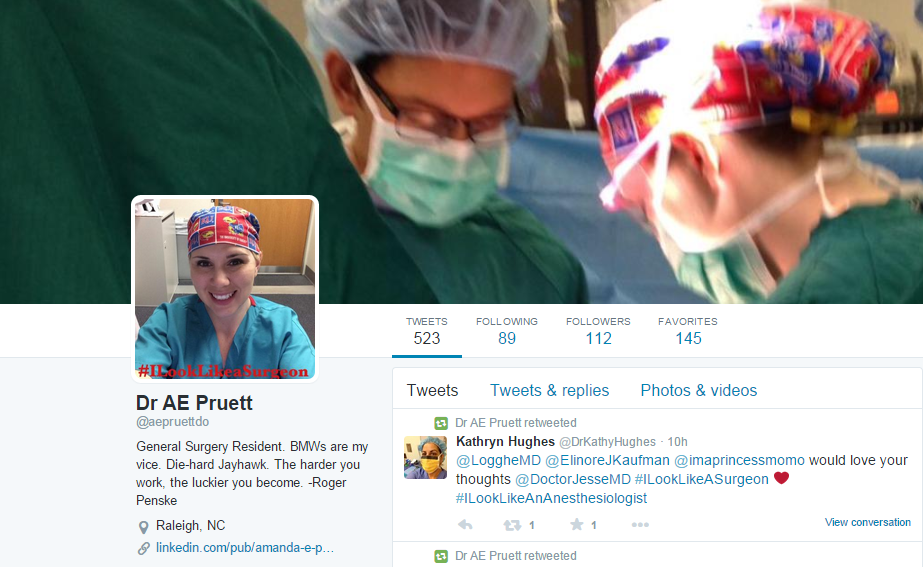
Don’t be an egg head. Add a personal picture to your profile.
Many Twitter users will not follow accounts without a profile picture on the assumption it is a fake account. A study  published by researchers from Microsoft and Carnegie Mellon University, “Tweeting Is Believing? Understanding Microblog Credibility Perceptions,”  analyzed how users assess Twitter credibility. The study found that:


  • users are poor judges of truthfulness based on content alone, and instead are influenced by heuristics such as user name when making credibility assessments.
  • users represented by the default Twitter icon, or a cartoon avatar are perceived as significantly less credible than users with  a personal photo.
The phrase “egg head” refers to Twitter’s default  profile image. As soon as you have created your Twitter account, you should replace the default image with your own picture.  This is easily done in your Twitter account settings. Twitter is about human connections. When uploading a picture, don’t use a cartoon, or any other animate or inanimate object for your profile. A professional close-up head shot works best.  You also have an opportunity to personalize your profile by uploading a custom header image alongside your profile picture. Use this opportunity to bring more authenticity to your account, as this image shows.


Create your Twitter bio


Add your (real) name, provide a brief bio and include a link to your institution’s website, and/or your LinkedIn profile so people can learn more about you. If you are hesitant to identify yourself, then consider if Twitter is the right platform for you. You may be better with a LinkedIn account which is restricted to connections you control. Remember on Twitter your tweets are there for all to see.  


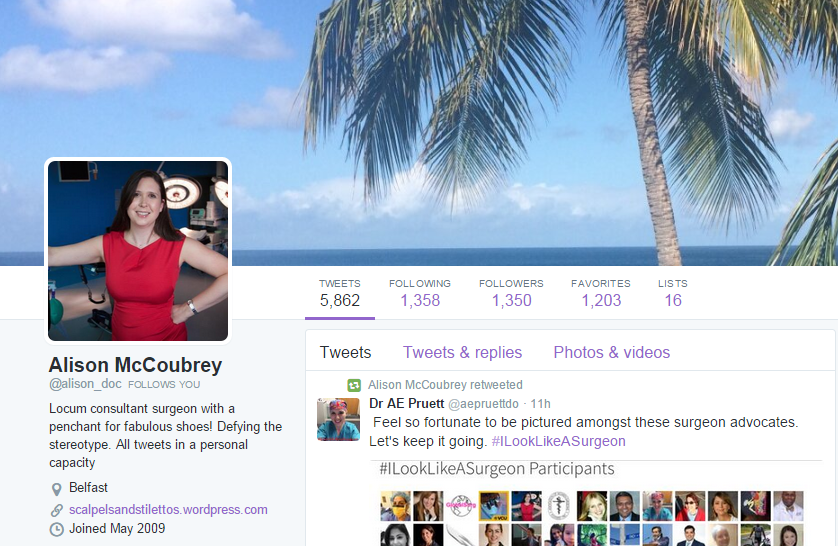
You may also wish to add a medical disclaimer to your Twitter profile, which states that you do not offer medical advice through social media, and/or the views you express are yours and not that of your employer. Finally, don’t be afraid to inject a little personality into your bio as this example illustrates.


Find People To Follow


Next you will want to find some people to follow. Use this list  of Surgeons on Twitter http://list.ly/list/lX1-surgeons to discover some surgeons who are already established tweeters. The list is updated regularly with new names so check back regularly and tweet me @JBBC if you wish to have your name added to the list.


While you will want to follow friends and colleagues, don’t restrict yourself to just this list. One of the great benefits of Twitter is its ability to be a global melting pot of ideas and people to learn from.  Including a diverse mix of health care professionals, policy makers, and patient opinion leaders in your Twitter mix will enhance your learning and professional development. You will find a wealth of knowledge and an opportunity to contribute your expertise through following health related hashtags. Some of the best conversations happen through the medium of Twitter chats.  These are pre-arranged chats which include a predefined #hashtag which links the tweets together in a virtual conversation. You will find a full list of health hashtags via Symplur's Hashtag Project.  


Send Your First Tweet
Now all that remains to do is to send your first tweet. This is an important step. A Twitter profile without any tweets may be mistaken for a spam account.  If you are not sure what you should tweet, try something simple, like introducing yourself to the Twittersphere.
Your professional reputation online is just as important as offline. Your Twitter account is one of the most visible descriptions of you on the Internet, so make sure it is projecting the best professional image.  Follow the steps I have outlined and you will be ready to create a Twitter account which will enhance your reputation both on and offline.


About the Author

Marie Ennis-O’Connor is a writer, keynote speaker and social media consultant, specializing in healthcare communications.  Follow her on Twitter @JBBC

Monday, August 24, 2015

#ILookLikeASurgeon: Being Queer in Surgery

Elinore Kaufman, MD

@ElinoreJKaufman

Surgery has a rich culture, full of strengths that exceed and defy the stereotype of surgeons as privileged white men who believe they are gods. In surgery there is a shared commitment to a goal, to individual excellence but also to true teamwork, to honoring the privilege of our patients' trust, to  finding problems and fixing them, to getting quickly to the heart of the matter, whatever it is. As a surgeon-in-training, I am learning how to perform operations, but I am mostly learning how to make high-stakes decisions in imperfect circumstances, and as an imperfect individual.
This is what makes being a surgeon the best job in the world, and it has been inspiring to see surgeons celebrating one another through #ILookLikeaSurgeon. The photos from around the world show a broad understanding of the people who bring diversity to surgery, but also of how our diverse backgrounds inform our work. As a queer woman and a surgeon, this conversation feels rich, inclusive and important.
As surgeons we have a lot in common, but we also bring our own unique experiences to the work. As I learn to operate, I draw on my attendings' teaching and expertise, my patients' generosity, but also on my background as an artist. Working with paint, fiber and clay has taught me the joy of working with my hands, learning new physical skills, and balancing speed and precision. I also bring my identity as a queer person to surgery. This can mean building a special bond with my lesbian, gay, bisexual, transgender and queer (LGBTQ) patients, making sure their partners, families, and identities are not only tolerated but welcomed. It can sometimes mean giving advice about anal sex after hemorrhoid surgery. It means always, always, always using the name, pronouns, and gender that a patient prefers.


Being queer in surgery means living in a world that assumes I am straight, and coming out over and over again. Although the reactions of my surgical colleagues are rarely hostile, they can be a bit awkward. Being queer in surgery also occasionally means pulling a colleague or student aside to tell them why I didn't laugh at a particular joke, or why they shouldn't assume that a married man has a wife. It also means letting some of these moments slide, wishing that it were someone else's turn to intervene.
I've been involved in LGBTQ organizing and activism in one way or another since middle school. I've been out since high school. It's a little bit about who I'm attracted to, and a lot about how I see the world. At the beginning of medical school I was one of two openly LGBTQ people in my class of 200, and I spent a lot of time not only explaining myself to my classmates and teachers, but also working for the inclusion of LGBTQ health issues into the curriculum.
For me, being queer in surgery means giving special attention to what alienation from healthcare feels like. Many of us from have experienced real discrimination at the individual or community level, leading us to present late or not at all; or to act in ways that perplex or annoy our doctors. Depending on our healthcare providers’ responses, this can lead to worse health outcomes. It also means being aware of  health disparities that affect LGBTQ people beyond HIV: disparities in cancer, mental health and substance abuse, as well as insurance and access to care.
It means being aware of transgender-specific health care: transgender people are among the only individuals who often need surgery just to be themselves. Trans people, often with limited resources, save money for procedures that can be life-saving, but that insurance often doesn't cover. They frequently travel for services that are only available in a few places. Not every trans person wants or gets surgery, and gender confirmation surgery is not in the scope of all surgeons’ training. But still, our  profession plays a critical role in transgender people's lives.
Thinking about the experiences of my LGBTQ friends and patients also gives me a special appreciation for surgeons just being surgeons. Surgeons like to get to the point, and we can be single-minded about it. We don't usually like endless debates or complications. While at times this might make us less sensitive to certain issues that affect our patients, it can also be a good way to approach everyone equally. For LGBTQ patients this can be an advantage. The average surgical history does not include a lot of invasive, personal questions. Being brisk can sometimes make us less judgmental, not more. So I was pleasantly surprised when, as part of a surgical team caring for  a transgender woman with acute cholecystitis, the only person who cared about her genitalia was the person putting in the Foley.
I approached #ILookLikeaSurgeon with some suspicion. I am a woman and a surgery resident, and I know there are not enough of us, especially in leadership and mentorship positions. But as a white, upper middle class woman with an elite education, I come to surgery with an enormous amount of privilege already, and this disparity does not seem like the most urgent one. In addition, many discussions of women in surgery often seem to assume a uniform experience about life as a woman and a surgeon, and as a queer person, my life works differently. The assumption is often that all the women in the room date and marry men; have children at all or in the same way; and think about childcare as primarily their responsibility. I know many colleagues find solidarity in these conversations, but these are not my assumptions or my experience, and I have often felt invisible in these conversations. In its own way, invisibility is as exhausting as Q3 call.
Like many, I had a baby during my research years. Unlike my straight female colleagues, my partner got pregnant and gave birth. I did not operate pregnant or miss clinical time for prenatal visits or maternity leave. But more than that, my partner was not raised to believe that someone else would be the primary caregiver, so there's no pressure from reversing stereotypical gender roles. When I finish research in June, I know I am going to experience stress and sadness from not spending as much time with my kid as I wish I could. I know many of the fathers I work with feel this tension as much as the mothers, even if they are not expected to talk about it. On the other hand, I do need to make sure that my job offers partner benefits for health insurance that will cover us all. I'm only going to let my career take us to cities where we feel comfortable; where we have community; and where we are going to feel okay about raising our kid without her feeling like she's always the only one who has to explain her family. There are some family-friendly towns and institutions that might not be as friendly to my family.


So yes, #ILookLikeaSurgeon, I act like a surgeon, and I also look and act like myself. Our diversity matters to us, and it matters to our patients. We can bring our whole selves to their care, and they need us to.
Elinore Kaufman, MD
@ElinoreJKaufman